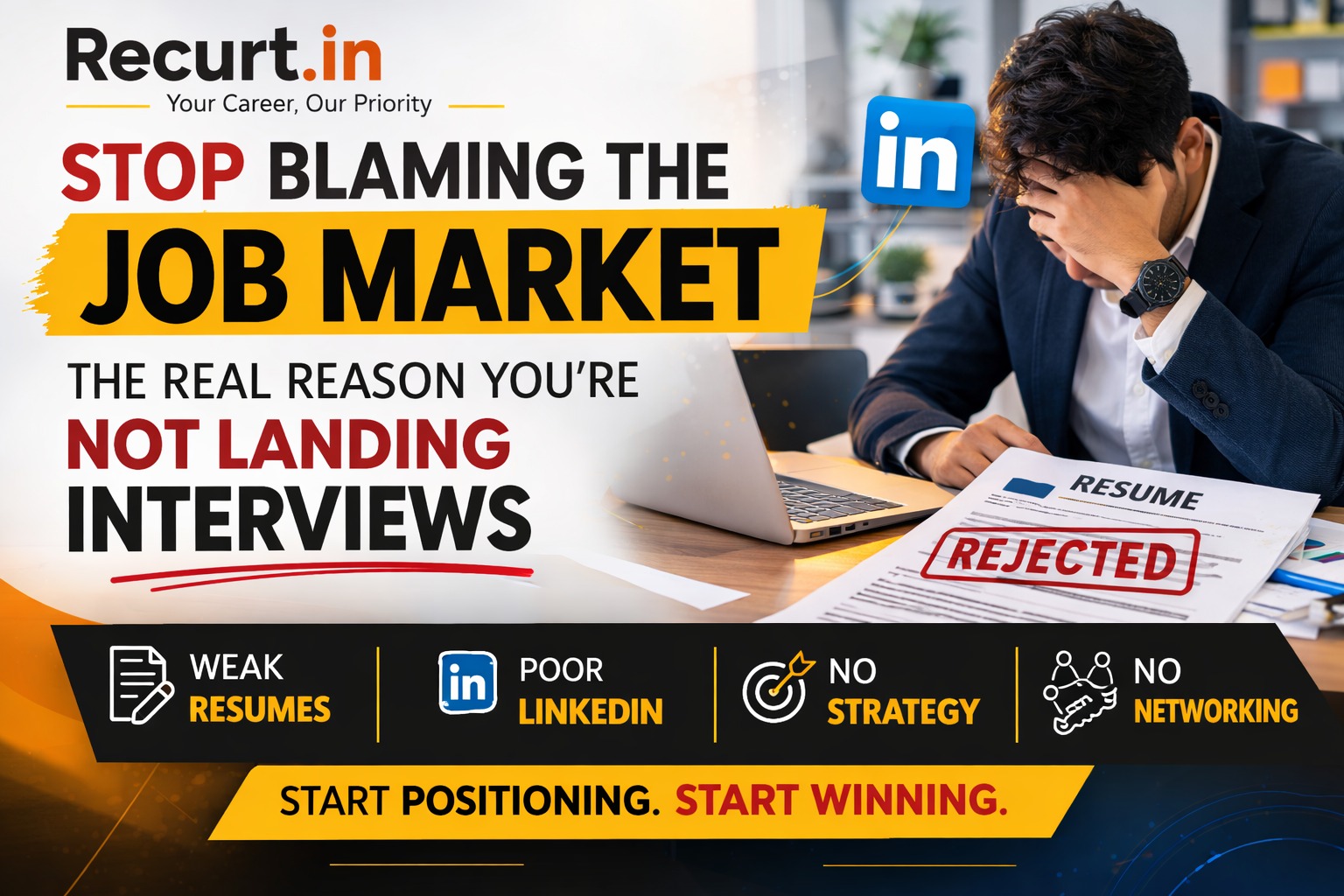
Job seekers believe the reason they are not getting interview calls is because the job market is difficult. They blame economic conditions, competition, automation, or hiring freezes. While these factors can influence hiring trends, they are often not the real reason candidates fail to secure interviews.
The truth is far more uncomfortable: the biggest problem is usually how job seekers position themselves.
At Recurt.in, after reviewing thousands of job listings and observing recruiter behavior, one pattern becomes very clear. Candidates often struggle not because opportunities are missing, but because their resume, LinkedIn profile, and job search strategy fail to communicate their true value.
Your resume should not simply list what you did at a job. Your LinkedIn profile should not be a copy of your resume. And applying to dozens of roles without strategy rarely produces results.
Employers today are searching for professionals who solve problems, deliver results, and create measurable value for their organization. If your resume reads like a generic job description and your LinkedIn profile lacks clarity or credibility, recruiters will simply move on to another candidate.
Understanding how to position your experience properly can completely transform your job search. When employers clearly see the impact you bring, interviews start becoming opportunities rather than rare events.
E-E-A-T Statement
Experience: The insights in this article are based on hiring trends, recruiter screening behavior, and job market observations from the editorial research conducted by Recurt.in, a platform focused on career opportunities and employment insights.
Expertise: The strategies discussed follow modern resume optimization methods, LinkedIn profile development frameworks, and job search best practices used by HR professionals and career advisors.
Authoritativeness: The recommendations align with hiring insights shared by recruitment professionals, talent acquisition leaders, and global job platforms.
Trustworthiness: Recurt.in provides independent and unbiased career guidance designed to help job seekers improve their visibility and success in competitive hiring environments.
The Hidden Reasons You’re Not Getting Interviews
1. Your Resume Reads Like a List of Responsibilities
One of the most common mistakes job seekers make is writing resumes that simply describe job duties.
Recruiters already understand what a role involves. They do not need a description of daily tasks. What they want to see is the impact you created and the results you delivered.
For example:
Weak resume statement:
Managed social media accounts for the company.
Stronger statement:
Increased social media engagement by 65% and generated 40% more inbound leads through targeted content campaigns.
The second example immediately shows measurable results. It tells the recruiter that the candidate can produce outcomes rather than simply complete tasks.
Your resume should focus on answering three important questions:
- What problem did you solve?
- What improvement did you create?
- What measurable results did you deliver?
When recruiters see clear achievements, your resume instantly becomes more compelling.
2. Applying to Roles That Do Not Match Your Experience
Another major mistake many candidates make is applying to roles that do not align with their experience.
Many job seekers submit hundreds of applications hoping something will eventually work. Unfortunately, this “quantity over quality” approach rarely leads to interviews.
Recruiters evaluate resumes very quickly. If they cannot immediately see how your experience matches the role requirements, your application may be rejected.
A more effective job search strategy involves:
- Targeting roles aligned with your skills and expertise
- Tailoring your resume for specific positions
- Highlighting relevant achievements that match employer needs
Strategic applications are significantly more effective than mass applications.
3. Your Resume Feels Generic
Recruiters review hundreds of resumes every week. Generic resumes are extremely easy to identify.
These resumes usually contain vague descriptions such as:
- Responsible for team coordination
- Assisted with project tasks
- Helped improve department operations
While these statements describe activity, they do not communicate value.
A strong resume should clearly demonstrate:
- Your professional achievements
- The problems you solved
- The results you delivered
When recruiters instantly understand your value, your chances of being shortlisted increase dramatically.
Understanding Applicant Tracking Systems
Many job seekers believe Applicant Tracking Systems (ATS) automatically reject resumes.
This is a common misconception.
ATS systems are simply software tools that help recruiters organize and search applications more efficiently. They store resumes and allow recruiters to filter candidates based on keywords, skills, and qualifications.
To make your resume ATS-friendly:
- Use clear formatting
- Include industry keywords
- Avoid complex design elements
- Use standard section headings
However, passing the ATS is only the first step. Your resume must also convince the recruiter that you are the right candidate.
This means combining technical optimization with compelling storytelling.
Why Many Professionals Undervalue Their Achievements
Another reason candidates fail to stand out is that they often underestimate their own impact.
Many professionals describe their experience in modest or vague terms. This can make their contributions appear smaller than they actually were.
For example:
Weak statement:
Helped with project management.
Strong statement:
Coordinated cross-functional teams to deliver a product launch two weeks ahead of schedule.
The second version demonstrates leadership, responsibility, and results.
If you do not communicate your achievements clearly, recruiters cannot recognize your true value.
Your LinkedIn Profile Could Be Holding You Back
LinkedIn Is Often the First Impression
Before inviting candidates for interviews, recruiters frequently review LinkedIn profiles.
If your profile is incomplete or outdated, it can reduce your credibility instantly.
Common LinkedIn mistakes include:
- Weak professional headlines
- Missing experience details
- No measurable achievements
- Lack of professional engagement
Your LinkedIn profile should function as your digital professional brand.
LinkedIn Should Not Be a Copy of Your Resume
Many job seekers simply paste their resume into LinkedIn. However, LinkedIn offers much more than a static professional record.
A strong LinkedIn presence allows you to:
- Demonstrate industry knowledge
- Share professional insights
- Build meaningful connections
- Increase visibility among recruiters
Your LinkedIn profile should include:
- A clear professional headline
- A compelling summary explaining your expertise
- Detailed achievements within each role
- Skills relevant to your target career path
When optimized correctly, LinkedIn can significantly increase recruiter visibility.
Why Networking Matters More Than You Think
Many job seekers rely entirely on job applications.
However, a significant number of opportunities are discovered through professional networking and referrals.
Networking does not mean asking strangers for jobs. Instead, it involves building professional relationships by:
- Engaging with industry discussions
- Connecting with professionals in your field
- Sharing insights and ideas
- Participating in career conversations
When recruiters repeatedly see your name and contributions, they become more familiar with your expertise.
This familiarity can dramatically increase your chances of being considered for opportunities.
Why Blind Job Applications Rarely Work
Many candidates treat job searching like a numbers game.
They submit dozens or even hundreds of applications without researching the company or following up afterward.
This approach rarely leads to meaningful results.
Successful job seekers follow a more strategic approach:
- Identify companies they want to work for
- Research hiring managers and company culture
- Tailor their resume for the role
- Connect with professionals on LinkedIn
- Follow up professionally after applying
This strategy helps candidates stand out among hundreds of applicants.
Weak vs Strong Job Search Positioning
| Weak Job Search Approach | Strong Job Search Strategy |
|---|---|
| Resume lists responsibilities | Resume highlights measurable achievements |
| Generic resume for all jobs | Tailored resume for each role |
| Inactive LinkedIn profile | Optimized professional profile |
| Blind applications | Strategic applications |
| No networking | Active professional engagement |
The Truth About the Job Market
Yes, the job market can become competitive during certain economic periods.
However, candidates who clearly demonstrate their skills, achievements, and problem-solving ability continue to secure interviews even during challenging times.
Recruiters are not simply filling roles. They are searching for professionals who can deliver value and help organizations succeed.
When your resume and LinkedIn profile clearly communicate your impact, you move from being just another applicant to becoming a strong candidate.
Conclusion
The biggest obstacle in many job searches is not the market. It is positioning.
If your resume focuses on tasks instead of results, if your LinkedIn profile lacks clarity, and if your job search strategy lacks direction, recruiters will struggle to recognize your potential.
But the good news is that this problem is entirely fixable.
When you clearly communicate your achievements, optimize your professional presence, and approach your job search strategically, your chances of landing interviews improve dramatically.
At Recurt.in, we believe that every professional has value to offer. The key is learning how to present that value effectively.
Stop blaming the job market.
Start positioning yourself for success.
Your next opportunity may already be waiting—you simply need to show employers why you are the right person for the role.
Frequently Asked Questions
1. Why am I not getting interview calls despite applying for many jobs?
Often the problem is poor resume positioning or lack of measurable achievements.
2. What is the biggest resume mistake job seekers make?
Listing job responsibilities instead of highlighting achievements and results.
3. How important is LinkedIn in job searching?
LinkedIn is extremely important because recruiters frequently use it to discover and evaluate candidates.
4. Should I tailor my resume for every job?
Yes. Tailoring your resume to match the job description significantly improves your chances of getting shortlisted.
5. What makes a resume stand out to recruiters?
Clear achievements, measurable results, and alignment with the employer’s needs.
6. Do ATS systems automatically reject resumes?
No. ATS systems organize applications, but recruiters still review candidates before making decisions.
7. Is networking really necessary for finding jobs?
Yes. Many opportunities come through referrals and professional connections.
8. How can I improve my LinkedIn profile?
Use a strong headline, highlight achievements, and stay active by engaging with industry discussions.
9. What is the best job search strategy?
Target specific roles, tailor your resume, and build professional connections.
10. What is the most important factor in landing interviews?
Clearly communicating the value and impact you bring to potential employers.